

Forex Support And Resistance Levels Daily
What's Inside?
- How to notice key support and resistance levels in whatsoever market place
- How can I trade support and resistance zones, either using stop of day price activity or intraday strategies?
- Why is it hard to find adept support and resistance levels to trade?
If there is a subject which repeats itself amongst traders who are struggling with toll action, agreement and trading key support and resistance levels would be near the meridian of the list.
Common questions struggling traders enquire are:
- How practice I know if a support or resistance level volition agree?
- If I accept a full time job, and am trading end of day (or daily/4hr fourth dimension frames), how exercise I choose the best support and resistance levels?
- How tin can I find the all-time support and resistance levels for trading?
Have you asked any (or all) of the higher up questions when learning trading online? Felt confused well-nigh understanding key back up and resistance levels? If so, and so pay attending to this article as we're going to put many pieces of this puzzle together regarding key support and resistance levels, along with how to trade them.

Fundamental Point #ane: How Professional Traders Relate to Support and Resistance Levels
Anyone who has seen how professional traders trade know they often place their orders alee of time and less often do marketplace orders. A full general theme that shows upward is about 70+% of all institutional orders are placed at prices ahead of time, while <xxx% are market place orders.
Now every institution and trader has their ain arroyo. Some use price activeness, some use the ichimoku cloud, some utilise fibonacci levels, some utilise indicators, etc. Regardless, none of that matters.
What does matter is all of them are paying attending to key support and resistance zones. These ' zones ' are where they most oftentimes place their orders. Now it'south important to understand that each trader and establishment has their own 'property time', meaning how long they like to concord their positions.
Traders who accept shorter holding periods will oft crave a smaller stop. Hence they will want to get as shut to the support/resistance level as possible to create the smallest terminate available while maximizing their upside. Traders with longer holding times won't crave as much precision and will likely take a larger stop loss to avoid getting kicked out of modest swings to capture the underlying trend.
At present to requite y'all a visual of how this works, lets await at the chart below on the USDJPY weekly chart.
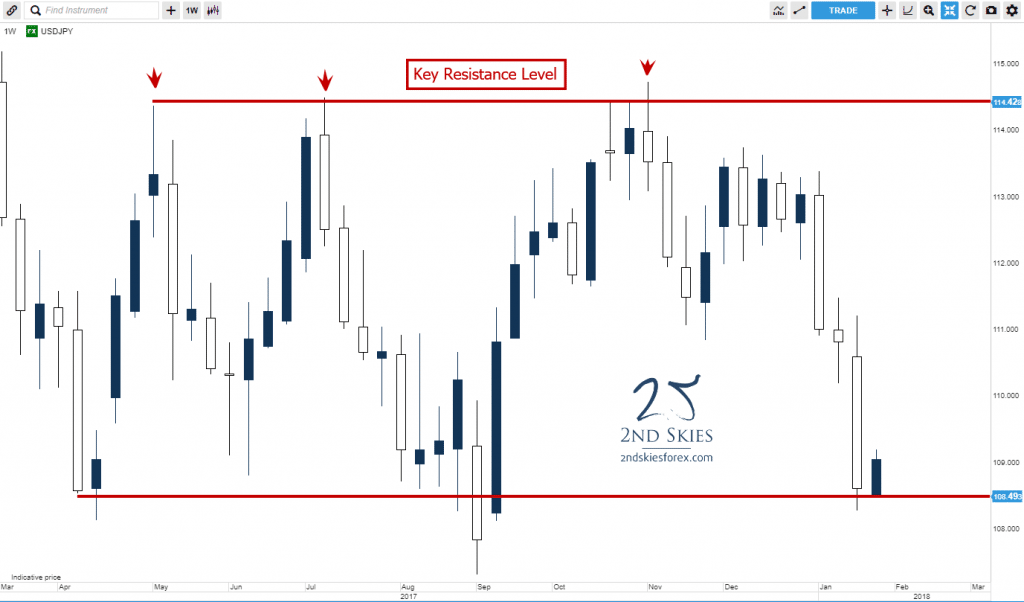
As you tin can encounter from the chart higher up, I've fatigued a line on top near 114.42 which I announce every bit 'resistance'.
Now here is how professional traders volition attack this using the next chart below.
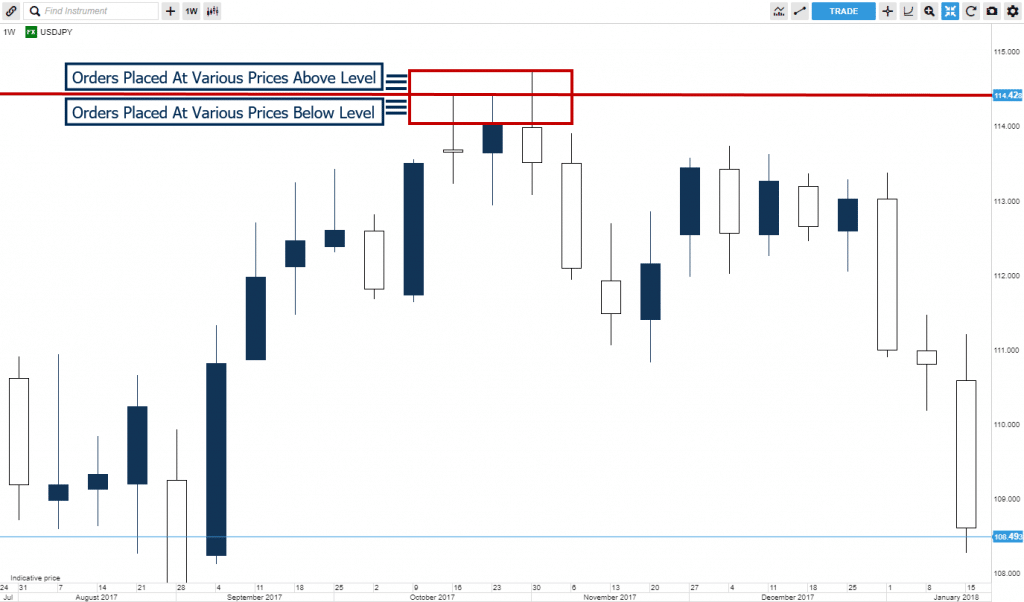
If a professional trader is surly on the USDJPY (or thinks it's in a range), they'll sell the pair at or near 114.42. However, every bit I stated above, they'll have different belongings times and finish loss sizes. And so what the order flow will look like is you lot'll run into various orders placed below the 114.42 level, while some will be to a higher place.
In this case, because ii of the 3 wicks (in the chart above) which striking the resistance level stopped on a dime, you can assume in that location were a fair amount of orders just beneath the level. What you'll also notice is the 3rd wick pierced through the 114.42 level, either due to a) bulls trying to push through resistance and see if they can produce a breakout trade setup, or b) traders finding liquidity but to a higher place it.
If you were able to somehow see the combined global guild volume for these 3 candles, most likely you'd meet something similar below:
Sell 10m 114.00
(with various orders selling between here and 114.42)
Sell 10m 114.42
(with diverse orders selling between here and 114.72)
Sell 20m 114.72
(with merely a few orders above, peradventure upward to 115).
While this is an overly simplified description of the guild flow around this central resistance level, it serves an of import point. Which is, it's of import to understand professional traders will place their orders at or around key levels . The variance in how they identify their orders in a higher place/below these levels creates a 'zone' of orders, which defend a level, and thus create 'resistance'.
If the sell orders are enough to concur any bullish pressure level, the pair will sell off. If not, a breakout will likely occur, or a complex corrective structure will form.
At present the cardinal accept-home point here is: professional traders who are spotting the aforementioned level/price will well-nigh likely place their orders at/to a higher place/or below said price. This is what creates the 'zone' effect, so endeavour to avoid thinking key back up and resistance levels equally clear/perfect lines in the sand.
Key Point #2: The Larger The Back up or Resistance Zone, The Greater the Variance in Orders Behind That Zone
In the prior USDJPY chart, the resistance zone was pretty small (about thirty pips from top to bottom). This makes it pretty easy to go some precision when selling at a key resistance zone.
But what happens when the support or resistance zone is much wider, say 100 pips or more? How do I trade that? Great question which I'll answer below.
See the NZDUSD weekly chart, which currently has a wide resistance zone between .7312 and .7556, over 240 pips!
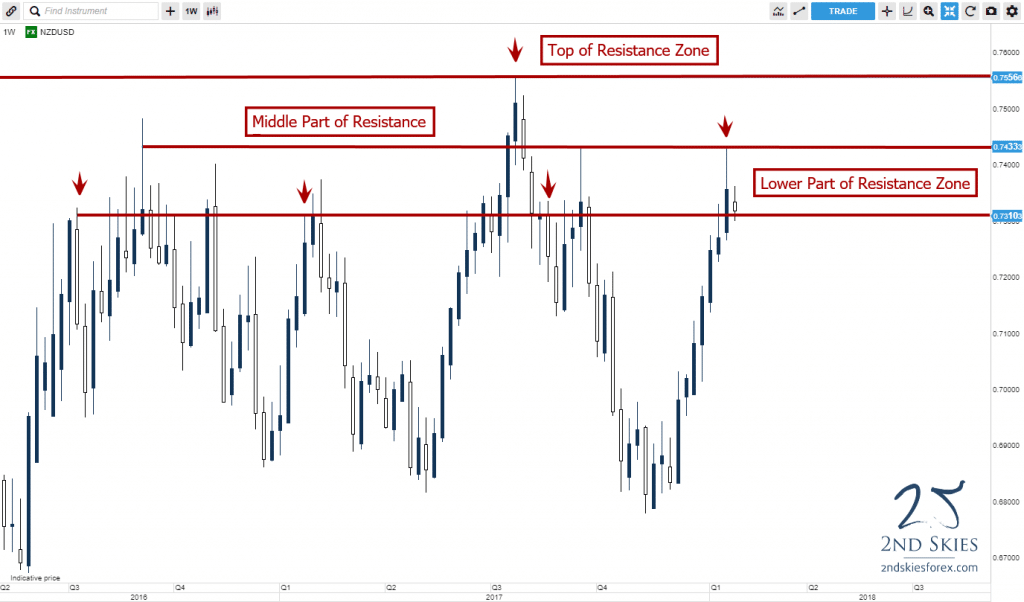
When you have such wide resistance zones, it means there is less 'understanding' in the guild catamenia between the bears in the market.
There are bears which feel .7310 is a decent resistance (as evidenced past the fact but 13 candles have closed above this since late Q2 2016). There are bears which feel strongly almost .7433 being resistance every bit the pair has had only 2 weekly closes above this price since Q2 2016. And and then there are bears which felt the extreme values for this pair should not exceed .7556. This is clearly shown since the kiwi could not produce 1 weekly close above this price.
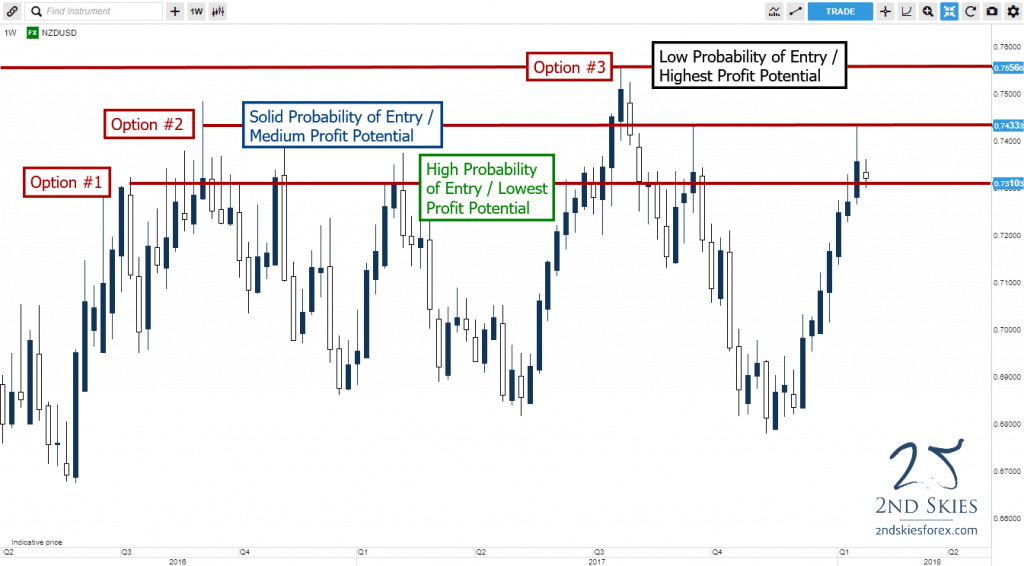
And then there is a lot of 'disagreement' specifically where resistance is, simply there is understanding that this 'zone' is resistance. At present anytime you encounter a zone (wide or small), y'all are faced with the aforementioned 3 trading choices when information technology comes to shorting it:
Support & Resistance Zone Trading Option #1: If y'all want the highest probability of getting in the trade, you'll desire to target the lesser of this resistance zone (flip this for support zones…e.g. top of the zone). By getting in a role of the resistance zone often touched, you're increasing the probability you lot'll get into the trade. The downside = a wider terminate loss, which likewise reduces your potential profit.
Support & Resistance Zone Trading Option #2: If you desire a solid probability of getting in the trade, while not wanting such a huge stop loss, y'all'll want to get in somewhere within the zone (ideally closer to the middle). This will slightly decrease the probability your trade will activate, but will increment your turn a profit potential since you'll have a smaller stop loss and thus greater target.
Support & Resistance Zone Trading Selection #3: If yous desire the highest turn a profit potential, then you'll want to get in at the highest point in the zone (.7433 or in a higher place). The upside here is you can have the smallest end loss possible, and thus the greatest profit potential. The downside is your merchandise is less likely to become activated (i.e. .7433 was only striking 4x since Q2 17′, while .7310 was hit almost 25x).
To analyze, I have a nautical chart below for you using the same Kiwi pair to demonstrate this.
And so that is the 'framework' for how to think about support and resistance zones and how you should trade them. You'll need to decide how you want to trade that zone based upon probability and turn a profit potential. Neither selection is better or worse per se stylistically. Yous'll have to find which of the 3 is nearly natural to y'all.
Cardinal Point #iii: Trading Support and Resistance Zones Means Trading 'Probabilities'
I think one of the biggest confusions most trading price action using back up and resistance levels is understanding probabilities , and relating to trading (or taking your trades) based on probabilities. This 'confusion' has been perpetuated by a mutual 'narrative' that you should wait for 'confirmation price action signals'.

Supposedly yous exercise this to 'confirm' the level will agree, and thus exist more 'likely'. The fact of the affair is, most professional traders have already decided what level and toll they desire to enter, well before any said pin bar, fakey or 'confirmation price action signal' has formed.
The underlying social club catamenia is generally clear to most professionals before these i-ii bar candlestick patterns have even formed, so they know which management is more 'probable', along with their trade location.
And because nobody to date, after decades, has been able to plant with a verified live trading account, or with statistics that trading pin bars off key levels gives you lot a greater probability the trade will piece of work out ( + profit ), this narrative is quite dubious and making traders more confused about trading cardinal support and resistance levels. Just I digress…
When you eddy it downwardly, there are ii key points to sympathize here:
#one: Either the level volition hold or non
#2: The lodge flow (and probabilities) are nearly likely in place whether a key support or resistance level will concord (or non)
"What the above means is y'all will never 'know' if the level will hold or not. Y'all merely take probabilities to work with. Hence you have to approach it 'probabilistically' (which negates looking for 'confirmation')"
The all-time way to determine either of the above is by learning how to read price action context and the order flow backside it. The context will create a 'construction' which is reflective of the underlying gild flow. 1-ii candlesticks likely isn't going to change that, nor are they more than important than an entire construction. Hence, when you tin can acquire to read toll action context and structures, you'll exist able to meet which level is more than likely (and probable) to hold (or not).
Past doing this, you'll be getting amend merchandise locations than you would with whatever pivot bar or confirmation price activeness signal. I demonstrate this clearly in my latest live merchandise video for +480 pips and +5R turn a profit. Try to find a improve entry using a pin bar (you won't).
Hence by learning to trade without confirmation cost activity signals, and to empathise the context in terms of probabilities, you'll avoid missing perfectly expert trades.
And if you lot look at my USDJPY or NZDUSD charts, you'll see there were very few confirmation price activity signals hither, which = lost trades and profits.
USDJPY Weekly Nautical chart
NZDUSD Weekly Nautical chart
My guess is if you lot were to identify many fundamental support and resistance levels over years and years of price action that produced great trading opportunities, you'll encounter many times there were little or no pin confined, or any kind of confirmation price activeness signals, thus a lot of lost profits missing these high quality trades.
In Summary
So I've covered a lot of ground here regarding key support and resistance levels. The central points and methods I talked about to a higher place apply to any musical instrument, any time frame, or environment.
It's important to note at that place is a lot more to understand when trading or finding central support and resistance levels. Such as how 'clean' a level is, when a level is more probable to hold (or neglect), what are the all-time levels to trade, how to find cardinal levels using daily nautical chart strategies, trading intraday, and more.
This is a big subject field that cannot exist unpacked fully (or well) in a single article. And information technology's a skill you'll need to build over time through practice, analysis and feedback from a professional trader and mentor.
At present if you want to learn more near forex trading cardinal support and resistance levels, and improve your ability to find the best ones to merchandise, then check out my online price action course where we take over 5 hours of video lessons on this, forth with quizzes, analysis and feedback from me and my senior students on how to observe and trade the all-time levels.
Now Your Turn
Did you discover this back up and resistance level article useful and acquire something new? If and so, and so make sure to leave your comments below, forth with share/like/tweet it with others.
I'll await forward to hearing from yous.

Forex Support And Resistance Levels Daily,
Source: https://2ndskiesforex.com/trading-strategies/forex-traders-can-find-best-key-support-resistance-levels/
Posted by: siskyouche.blogspot.com
0 Response to "Forex Support And Resistance Levels Daily"
Post a Comment